Showing 97–108 of 226 results
-

‘Koto hime’ is a dwarf Japanese maple with a very upright, very dense habit, famous for its tiny leaves packed tightly along the shoots. In spring, the foliage starts pink to orange-red, then turns light green in summer. In autumn, it colours yellow mixed with orange. A collector cultivar, ideal in a pot and highly appreciated for bonsai training.
-
‘Koto maru’ is a dwarf Japanese maple—very dense and very slow-growing—originating from a witch’s broom mutation. It is recognised by its small leaves, whose central lobe is often shorter and rounded, giving a very distinctive look. In spring, the foliage starts yellow-green with bronze to orange-red edges, then turns green in summer. In autumn, it colours mainly yellow to orange, sometimes finishing with a redder touch. Perfect for containers and small spaces.
-
‘Koto no ito’ is a Japanese maple with very distinctive foliage: extremely fine lobes, almost “thread-like”, creating a light, highly graphic silhouette. In spring it starts a vivid green, stays green in summer, then autumn turns yellow-orange to orange, sometimes with red nuances depending on conditions. An elegant cultivar, superb in a container as well as in the garden.
-
‘Koyamadani nishiki’ is a collector Japanese maple, sought after for the unusual shape of its leaves: the lobes end in rounded tips, giving an almost “snowflake” look. In spring, it often leafs out a soft yellow-green with a pink to reddish edging, then turns green in summer. In autumn, it colours in yellow-orange tones that can shift towards orange-red. A very decorative cultivar for containers and small gardens, best placed near a walkway so you can enjoy the details.
-
‘Koyuki’ is a very original Japanese maple, appreciated for its netted variegation: at budbreak, it looks like a snowflake drawn by darker veins over a white to cream background. In summer, the foliage turns light green, then autumn colours in orange-yellow. A luminous cultivar, superb in a container or a small garden, best placed in bright partial shade to preserve foliage quality.
-
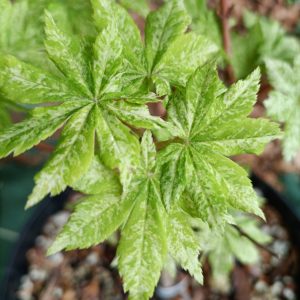
‘Kumoi nishiki’ is a variegated “full moon” type maple, valued for its very stable cream-on-green mosaic throughout the season. Budbreak can be pale, sometimes pink-tinged, then the foliage turns green speckled with cream; autumn generally shifts to yellow to orange tones. Upright silhouette, particularly interesting in a container or in a carefully chosen spot in the garden.
-
‘Kurabu yama’ is a Japanese maple with a rather upright habit that can broaden with age, appreciated for its very deeply cut green foliage with a light, airy look. Budbreak may show a reddish tint before quickly turning green for the season. In autumn, it develops a very spectacular display, often a luminous yellow first, then orange, with red touches. A characterful cultivar, highly decorative in a pot as well as in the garden.
-
‘Kurenai jishi’ is a dwarf Japanese maple with a very compact, very dense habit, often compared to a red ‘Shishigashira’. Its leaves are wavy / crinkled and held tightly along the shoots, giving a very structured silhouette. In spring, the foliage emerges deep red, then often shifts towards purple or red-green tones in summer. In autumn, it delivers a particularly decorative orange to red blaze. Ideal for containers and small spaces.
-
‘Kurui jishi’ is a very original Japanese maple thanks to the texture of its leaves: small, crinkled, with rolled edges—sometimes to the point of looking almost “star-shaped” in summer. The foliage is dark green through the season, then autumn lights up in yellow-orange to orange, sometimes with red nuances. Its habit is compact, dense and rather upright: an excellent choice for containers and small gardens.
-
Larix gmelinii var. olgensis (Olga larch / “Olga Bay larch”) is a deciduous conifer: it carries green needles in spring and summer, then turns a beautiful yellow in autumn before shedding. Very hardy, it thrives especially in climates with cool summers and cold winters. Its young conical shape becomes broader and more expressive with age, making it an excellent architectural tree for large gardens and parks, in soil that stays moist but well-drained.
-
Larix laricina (tamarack / American larch) is a deciduous conifer: its green needles form a light, airy mass in spring and summer, then turn golden yellow in autumn before falling. Very cold-hardy, it appreciates moist (even waterlogged) soils, while still being able to grow in cool, well-drained ground. A superb structural tree for large gardens and parks, especially striking near a water feature.
-
‘Leopoldii’ is a particularly decorative sycamore maple thanks to its changing foliage: in spring, the young leaves open with a pink tone, then turn green with irregular yellow-to-cream blotches (sometimes paler in summer). It is a structural tree, much larger than a Japanese maple, ideal as a specimen in a spacious garden to fully enjoy the variegation, which is especially spectacular at budbreak.